
How Much Is My Art Worth? What an Online Art Appraiser Looks for Before Determining Value

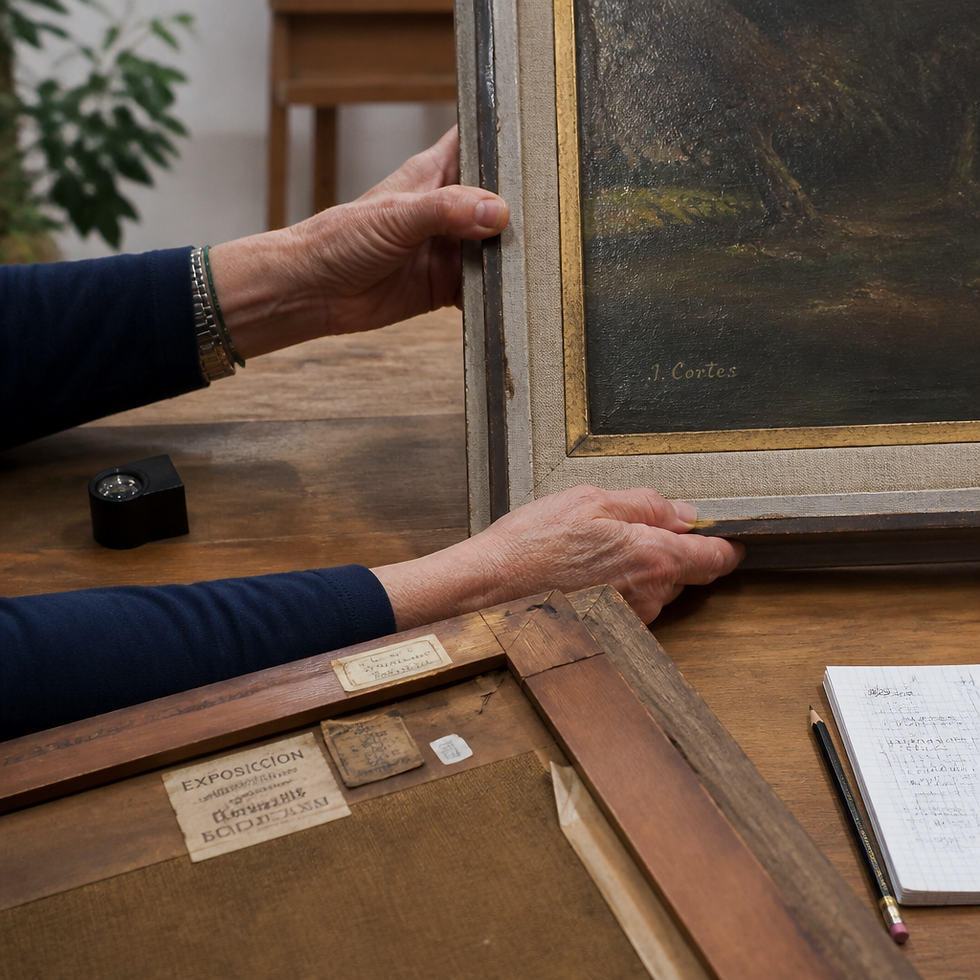
Finding an old painting in your home, inheriting an artwork, or discovering an unfamiliar artist's signature often leads to the same question: How much is my art worth?
The answer rarely depends on the appearance of the artwork alone. Professional art valuation combines identification, historical research, condition assessment, provenance, authenticity considerations, and evidence from the current art market.
Understanding these factors can help you decide whether an artwork deserves further research or a professional online art appraisal.
1. Identifying the Artist
The first question is usually: Who created the artwork?
A visible signature can provide an important clue, but signatures must be investigated carefully. Artists changed their signatures throughout their careers, and signatures can also be added to artworks later.
An appraiser may compare:
signatures and monograms;
inscriptions and dates;
labels and stamps;
exhibition labels;
gallery or auction labels;
inventory numbers;
stylistic characteristics.
An unidentified painting should not automatically be considered worthless. Attribution sometimes begins with clues found on the reverse of the artwork rather than the image itself.
2. Age and Period
Determining when an artwork was produced can significantly change its interpretation.
The appraiser may examine the materials, support, frame, canvas, paper, pigments visible in photographs, labels, inscriptions and construction methods.
Historical context is also important.
A painting associated with an artist's particularly significant period may have a different market from a similar work produced at another stage of the artist's career.
3. Medium and Technique
Oil paintings, watercolors, drawings, prints, photographs and mixed-media works belong to different markets.
Even works by the same artist can have dramatically different values depending on whether they are:
unique paintings;
works on paper;
drawings;
limited-edition prints;
artist's proofs;
workshop pieces;
later editions or reproductions.
Correctly identifying the technique is therefore an essential step before researching value.
4. Provenance: Where Has the Artwork Been?
Provenance is the documented history of ownership of an artwork.
Useful evidence can include old invoices, gallery labels, exhibition catalogues, auction records, collection stamps, correspondence, photographs and inheritance documents.
Strong provenance can help establish the historical identity of an artwork and, in important cases, contribute significantly to authentication research.
This is why owners should preserve old labels and documents even when they appear insignificant.
5. Condition
Condition can materially affect market value.
An appraisal may consider:
tears or punctures;
paint loss;
craquelure;
staining;
fading;
previous restoration;
overpainting;
relining;
structural damage.
Restoration does not automatically make an artwork undesirable. Its significance depends on the artist, period, rarity of the work and extent and quality of the intervention.
6. Authenticity and Attribution
A signature is not proof of authenticity.
Responsible authentication considers multiple forms of evidence, including stylistic consistency, provenance, materials, technique, documentation and comparison with securely attributed works.
In some cases, photographs and documentary research allow a useful preliminary assessment. In others, physical examination, conservation expertise, scientific analysis or consultation with a specialist may be required.
The appropriate conclusion may also be more nuanced than simply “authentic” or “fake.”
An artwork might be classified as attributed to an artist, from the artist's circle, workshop or school, or remain unidentified when the available evidence is insufficient.
7. Comparable Sales
After the artwork has been identified as accurately as possible, the appraiser can investigate the market.
Comparable sales may include artworks by the same artist with similar:
subject;
dimensions;
medium;
date;
quality;


Comments