
How Much Is My Painting Worth? How to Identify a Valuable Painting Online

Updated: Sep 5
A painting found in an attic, bought years ago at an estate sale, or inherited from family can raise one irresistible question: could this be valuable?
Sometimes the answer is yes. More often, value depends on a chain of evidence. A signature helps, but it is only one clue. Labels on the reverse, old exhibition records, the artist’s market, condition, size, subject, and comparable auction results can all affect what a painting may be worth.
If the question is How much is my painting worth?, the best first step is not guessing. It is careful looking. The more evidence you gather, the easier it becomes to move from curiosity to a credible opinion of value.
How do I know if my painting is valuable?
A valuable painting usually gives more than one signal. One clue can be interesting. Several clues that support each other can become persuasive.
Start with these questions:
Is there a readable signature or monogram?
Can the artist be identified?
Are there gallery labels, auction tags, or stamps on the back?
Is there family history, a receipt, or a written provenance?
Does the subject match what the artist is known for?
Is the painting an original work rather than a print or reproduction?
Is the condition stable?
Have similar works sold at auction?
This is the basic process behind painting identification and professional art appraisal. The goal is to connect the object in front of you with a real artist, period, market, and sales history.
A painting does not need to be famous to have value. Regional artists, 19th-century portraits, European landscapes, modernist works, folk art, maritime scenes, still lifes, and inherited academy paintings can all have a market. Value rises when the work is by a known artist, well documented, desirable in subject, in good condition, and supported by comparable sales.
What clues should I examine before getting a painting appraised?
A strong appraisal begins with observation. Before looking for an art appraisal online, gather the details that an appraiser, auction specialist, or art historian would ask for.
Check the signature, but do not rely on it alone
A signature can help with artist identification, but it does not prove authenticity by itself.
There are several reasons:
Artists changed their signatures over time.
Some paintings were signed later by dealers, owners, or restorers.
Copies and forgeries may carry convincing signatures.
Students and followers sometimes copied a master’s style and name.
A real signature on a damaged or weak work does not always mean high value.
A signature should be compared with known examples, but it also needs support from style, materials, provenance, labels, and expert attribution. This is where artist attribution and art authentication become separate from simple name matching.
If the signature is hard to read, photograph it clearly rather than tracing it, repainting it, or trying to clean it.
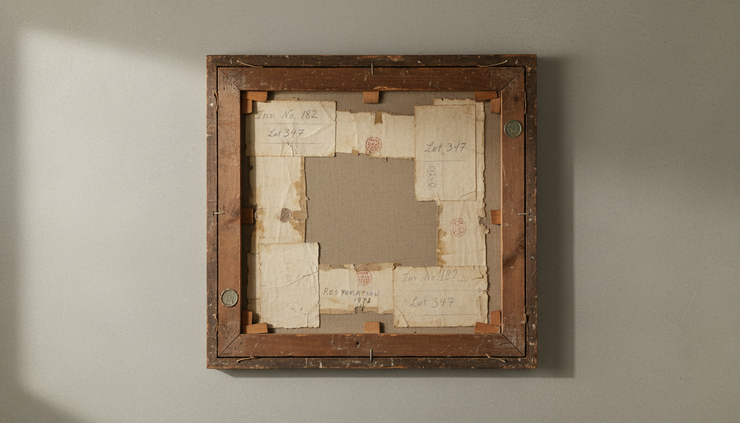
Look at the back of the painting
The reverse of a painting can be just as important as the front. Turn it over carefully and look for:
Gallery labels
Exhibition labels
Auction house stickers
Shipping labels
Inventory numbers
Estate stamps
Dealer stamps
Handwritten inscriptions
Old framing labels
Canvas supplier marks
These details can help establish provenance, which means the history of ownership. A painting with a documented chain of ownership is often easier to value than one with no background at all.
Labels can also place a work in a city, gallery, exhibition, or collection. Even a partial address or faded stamp may help narrow down the artist or date.
Identify the medium and materials
Medium affects both value and identification. An oil painting on canvas will often be assessed differently from a watercolor, gouache, pastel, acrylic, or mixed media work.
Look closely at the surface. Oil and acrylic usually show texture and brushwork. Watercolors often sit on paper behind glass. Pastels have a soft, powdery surface and are usually framed under glass. Prints may show dot patterns, plate marks, or a flat printed surface.
Common mediums include:
Medium | What to look for | Why it matters |
Oil on canvas | Raised brushwork, stretched canvas, old stretcher bars | Often associated with traditional easel paintings |
Oil on board | Painted hard panel, card, or wood support | Common for studies and smaller works |
Watercolor | Transparent color on paper, usually under glass | Sensitive to fading and condition issues |
Pastel | Soft, dry pigment under glass | Fragile surface affects handling and value |
Acrylic | Plastic-like paint film, often modern | Useful for dating postwar and contemporary works |
Measure the artwork and the frame
Dimensions matter. Measure the visible artwork first, then the framed size.
Use height by width, and record units clearly. For example, write “18 x 24 in” for the artwork and “24 x 30 in framed.” Do not guess.
Size affects value because collectors often prefer certain formats. A small study may sell for less than a finished exhibition painting by the same artist, while an unusually large work can be desirable if the subject and quality are strong.

How to find the value of an old painting through research
Learning how to find the value of an old painting means learning how the art market thinks. Sentimental worth, decorative appeal, insurance replacement value, and fair market value are not the same.
Fair market value usually means the price a willing buyer and willing seller might agree on in the open market. Auction estimates and past auction results often help establish this range, but they must be chosen carefully.
Compare the right auction records
Comparable auction results are one of the strongest valuation clues, but only if the comparisons are close.
A useful comparable should match several factors:
Same artist
Same medium
Similar size
Similar subject
Similar period
Similar quality
Similar condition
Similar level of documentation
For example, a large signed oil painting by a listed artist may not compare well with a small unsigned pencil sketch by the same artist. A finished harbor scene may not compare with a loose landscape study. A damaged painting may not compare with one in excellent condition.
Auction records can show whether an artist has an active market. They can also reveal which subjects collectors prefer. Some artists are best known for portraits, others for landscapes, city scenes, animals, marine paintings, still lifes, or abstract compositions.
Consider the subject and rarity
Subject can make a major difference. Collectors may pay more for works that represent an artist’s strongest period or most recognizable theme.
A rare subject can help, but rarity alone is not enough. A painting must still have quality, appeal, and a buyer base. A rare but unattractive or badly damaged work may be harder to sell than a more typical painting in excellent condition.
Common drivers of value include:
A known artist with auction history
A desirable subject
Strong composition and quality
Good scale for display
Original condition
Clear provenance
Inclusion in exhibitions or publications
Scarcity within the artist’s best work
Review condition honestly
Condition can raise or lower value sharply. Look for surface dirt, flaking paint, tears, holes, water stains, craquelure, fading, warping, overpainting, mold, or poor restoration.
Do not clean the painting yourself. Household cleaners, water, oils, and abrasive cloths can cause permanent damage. Even wiping a surface can disturb fragile pigment.
If a painting looks dirty, that may be fixable. If paint is lifting or the canvas is torn, the cost of conservation can affect fair market value. An appraiser can often tell whether condition issues are minor, serious, or worth professional conservation.
How much is my artwork worth online if I only have photos?
Many owners begin with the same practical question: how much is my artwork worth online if the expert cannot see it in person?
An online appraisal for old paintings can be useful when the photographs and information are clear. It can help with painting identification, artist research, preliminary valuation, and next steps. In some cases, it may also show when in-person inspection or formal authentication is needed.
Online opinions are strongest when the appraiser can see the whole object, not just the front.
Photograph the front clearly
Place the painting upright in natural, indirect light. Avoid flash if possible, since it creates glare and hides surface detail.
Take:
One straight-on image of the full front
One image with the frame included
One closer image of the main painted area
Detail shots of faces, figures, buildings, boats, animals, or other important features
Keep the camera level. Do not crop the edges. If the painting is behind glass, angle it slightly to reduce reflection, but also include one straight view.
Photograph the back and labels
The back can hold the evidence that identifies the work. Take clear images of the whole reverse and every label or mark.
Include:
Full back of the painting
Stretcher, panel, or backing board
Gallery labels
Auction tags
Exhibition labels
Handwritten numbers
Stamps and seals
Old repair patches
Frame maker labels
If text is faded, take several photos from different angles. Side lighting can make inscriptions easier to read.
Photograph the signature and surface
For the signature, take one close image and one slightly wider image showing where it appears on the painting. This helps experts judge whether the signature fits naturally into the paint surface.
Also photograph:
Paint texture
Cracks or craquelure
Damaged areas
Canvas weave
Paper texture
Edges, if visible
Frame corners
Any plaques or nameplates
Do not remove a painting from its frame unless you know how to do it safely. Frames, old nails, brittle paper, and fragile canvas edges can be damaged easily.
How to identify a valuable painting before you sell or insure it
If you are trying to learn how to identify a valuable painting, think in stages. Identification comes before valuation. Authentication comes before certainty. A fair market value opinion needs evidence.
A practical sequence looks like this:
Record the basic facts.
Photograph the painting thoroughly.
Check the signature, labels, and inscriptions.
Research the artist or possible artist.
Compare similar auction results.
Review condition and restoration needs.
Ask for a professional art appraisal when value may be significant.
Understand artist attribution
Attribution describes how confidently a work can be connected to an artist.
Common attribution language includes:
Term | Meaning |
By the artist | Considered an original work by that artist |
Attributed to | Probably by the artist, but not fully confirmed |
Studio of | Made in the artist’s studio or under supervision |
Circle of | Made by someone close to the artist or period |
Follower of | Made in the artist’s style, often later |
After | A copy based on a known work |
These distinctions can change value dramatically. A painting “by” a major artist and a painting “after” that artist are very different in the market.
Separate appraisal from authentication
A professional art appraisal estimates value. Art authentication addresses whether the work is genuine.
Sometimes the same specialist can guide both questions. In other cases, authentication may require a catalogue raisonné, scholar, foundation, lab testing, provenance research, or in-person inspection.
For many privately owned paintings, an online assessment can identify the likely artist, period, medium, and market range. If the evidence points to a significant work, the next step may be formal documentation.
How to get an old painting appraised with the right information
If you are wondering how to get an old painting appraised, prepare a short, organized file before submitting it.
Include:
Clear photographs of the front and back
Close-ups of the signature
Images of all labels, stamps, and inscriptions
Artwork dimensions and framed dimensions
Medium, if known
Any known history of ownership
Where and when it was acquired
Receipts, letters, certificates, or estate documents
Notes on damage or restoration
A good appraiser will not value a painting based on the signature alone. They will look at the full set of clues: artist, attribution, age, medium, size, subject, condition, provenance, rarity, exhibition history, and auction records.
Also be clear about why the appraisal is needed. A valuation for sale, insurance, estate planning, donation, or personal knowledge may require different wording and levels of formality.

What is the next step if the painting might be valuable?
A painting with a signature, old labels, family history, and strong visual quality deserves careful assessment. The same is true for a work that resembles a known artist, has exhibition labels, or appears in an old inventory or estate record.
Avoid rushing to clean, reframe, restore, or sell the painting before identification. Small decisions can affect value. Even removing old labels from the back can erase useful evidence.
If the painting turns out to have modest market value, the process still gives useful clarity. If it has stronger value, the right documentation can help with sale, insurance, inheritance, or auction planning.
For professional painting identification, artist attribution, and appraisal guidance, you can submit the artwork to The Antique Cabinet for a careful review.
The most valuable clue is rarely one detail on its own. It is the story the details tell together: the hand that made it, the path it traveled, the condition it is in now, and the market for works like it.


Comments