
Why Provenance and Cataloguing Are Becoming More Important for Auction Houses


The auction market is changing.
Digital bidding has expanded the reach of regional and independent auction houses far beyond their traditional geographic boundaries. A collector no longer needs to be physically present in London, Paris, New York or another major art-market centre to compete for an object. At the same time, buyers have access to more information, more comparable sales and more competing catalogues than ever before.
In this environment, the quality of the information accompanying an object has become increasingly important.
A strong catalogue entry does more than describe what is being sold. It establishes context, documents what is known, distinguishes evidence from attribution and gives prospective buyers a clearer basis on which to evaluate the lot.
For auction houses, cataloguing and provenance research are therefore becoming increasingly connected to credibility, buyer confidence and the commercial presentation of a collection.
From Object Description to Object History
Traditional cataloguing begins with identification.
What is the object? Who made it? When was it produced? What materials and techniques were used? What are its dimensions, inscriptions, marks, labels and visible condition?
These questions remain fundamental, but sophisticated buyers increasingly want to understand something else:
Where has this object been?
This is where provenance becomes important.
Provenance is the documented history of ownership, custody or transmission of an artwork or antique. Depending on the object, research may involve:
previous owners and collections;
auction and gallery records;
exhibition histories;
invoices and collection inventories;
labels, stamps and inscriptions;
archival photographs;
catalogue raisonnés and scholarly literature;
import and export documentation;
family archives and estate records.
Sometimes the history is remarkably complete. In other cases, only fragments survive.
Professional provenance research does not require filling every gap. On the contrary, one of its most important principles is clearly distinguishing documented evidence, reasonable hypotheses and information that remains unknown.
Why Buyers Care About Provenance
For a prospective buyer, provenance can help answer several different questions.
Does the object's documented history correspond with its proposed age and attribution? Has it previously appeared at auction? Was it part of a known collection? Are there unexplained gaps in its ownership history? Do labels or inscriptions correspond with identifiable galleries, collectors or exhibitions?
These questions become especially significant when dealing with valuable paintings, works on paper, antiquities, Asian art, archaeological material and objects whose ownership history may have legal or cultural-property implications.
Provenance should not be confused with authentication. A prestigious ownership history alone does not prove that an artwork is authentic.
But provenance can form an important part of the broader body of evidence considered alongside stylistic examination, material analysis, documentary research, expert opinion and technical investigation.
The Catalogue Is Often the First Point of Due Diligence
For online buyers, the catalogue entry may be the first substantial encounter with an object.
Before requesting a condition report or contacting a specialist, a bidder may already be examining photographs, comparing previous auction results, searching an artist's catalogue raisonné and checking inscriptions or labels.
That changes the role of cataloguing.
A description such as:
“European School, 19th century, oil on canvas”
may technically classify an object, but it provides relatively little information.
A researched catalogue entry might instead explain the characteristics supporting the proposed dating, record the canvas and stretcher dimensions, transcribe inscriptions, identify old collection labels, discuss previous ownership where documented and reference relevant comparable works or archival records.
The object has not changed.
The information surrounding it has.
And information can materially influence how confidently a potential buyer understands the lot.
Cataloguing as Risk Management
Good cataloguing is also an exercise in precision.
Auction houses routinely encounter objects whose attribution is uncertain. The difference between terms such as:
“by,” “attributed to,” “studio of,” “circle of,” “school of,” “manner of” and “after”
can have substantial commercial significance.
Research therefore needs to support not only what a catalogue says, but also what it deliberately does not claim.
This is especially relevant when cataloguing estates and large private collections. Hundreds or thousands of objects may need to be processed within relatively short deadlines, while specialists must balance research depth against commercial practicality.
A structured research process can help identify which objects justify additional investigation.
A previously unidentified signature, exhibition label, maker's mark or inventory number may transform an ordinary catalogue entry into a much more informative one.
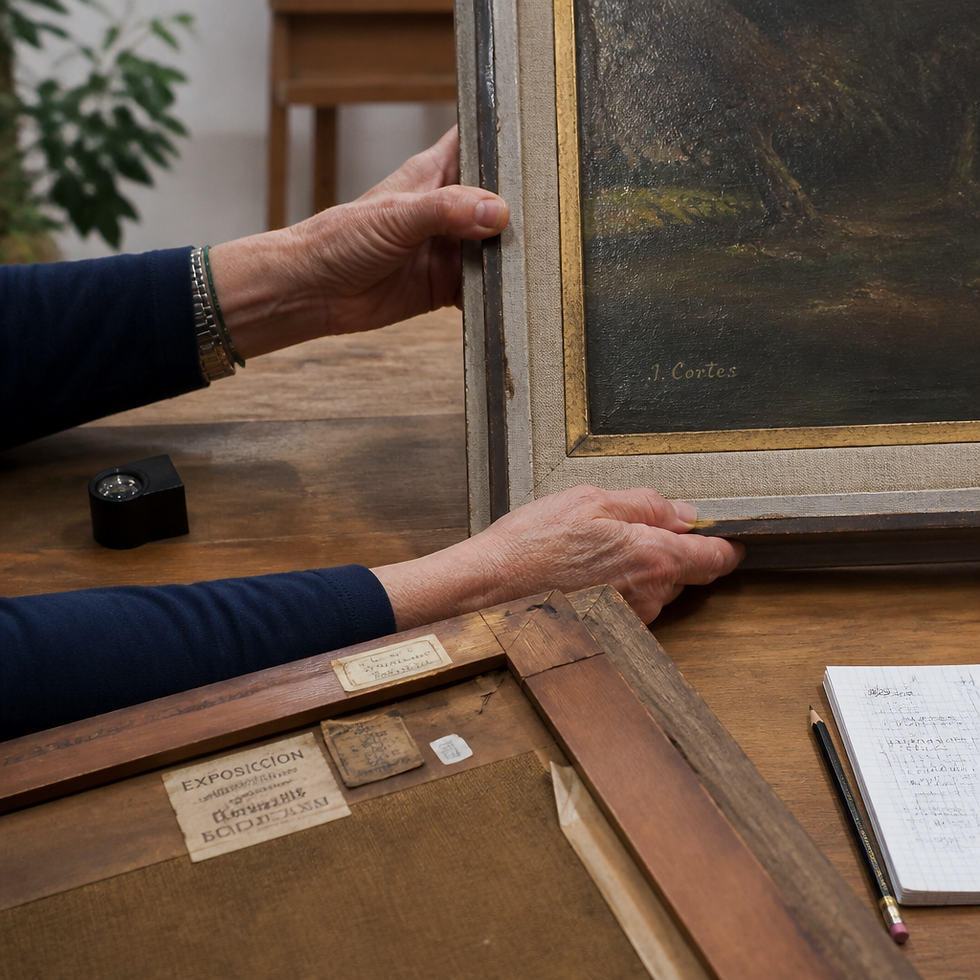
The Hidden Information on the Back of an Artwork
Some of the most useful evidence in provenance research is not found on the front of an artwork.
The reverse of a painting, frame or work on paper may contain:
gallery labels;
auction stickers;
customs stamps;
exhibition numbers;
collector marks;
handwritten inscriptions;
inventory numbers;
framers' labels;
transport labels;
old attribution notes.
Individually, these details may appear insignificant.
Together, they can provide clues to the object's movement through collections, galleries and exhibitions.
A partially damaged label may identify a dealer. An inventory number may correspond to an old collection catalogue. An exhibition sticker may lead to an archival catalogue containing the same artwork.
This is why detailed photographic documentation should be considered part of the research process rather than simply part of the marketing process.
Digital Auctions Have Raised the Value of Information
Online bidding has removed many geographical barriers from the auction business.
A regional auction house can now attract bidders from multiple countries. But those buyers may never inspect the object physically before bidding.
The result is an interesting paradox:
the more digital the transaction becomes, the more valuable reliable documentation becomes.
High-resolution photographs, accurate measurements, condition information, provenance, bibliography and carefully qualified attribution help compensate for the distance between the bidder and the object.
For international buyers, documentation may also assist with later questions involving insurance, resale, collection management, inheritance and further scholarly research.
Regional Auction Houses and the Opportunity of Research
The expansion of digital bidding has also changed the competitive position of regional auction houses.
Important objects do not exist only in major metropolitan collections. They emerge from estates, inherited collections and private homes throughout Europe, North America and elsewhere.
A regional auction house may therefore encounter an object whose importance has not yet been recognised.
The challenge is identifying it.
This is where research becomes commercially interesting.
A painting catalogued generically may contain a traceable exhibition label. An apparently anonymous piece of furniture may bear a workshop mark. A print may belong to a scarce state of an edition. An inherited Asian object may have a documented collecting history extending back several generations.
Research does not guarantee that an object will become valuable.
But it can reveal information that would otherwise remain invisible.
Provenance Is Also About Transparency
There is another reason provenance has become increasingly significant: scrutiny surrounding the movement of cultural property.
Museums, collectors, dealers and auction houses operate in an environment of increasing attention to ownership history, restitution claims, archaeological objects, wartime displacement and illicit trafficking.
The appropriate level of investigation varies considerably depending on the category, age, origin and value of an object.
Nevertheless, identifying gaps or potentially sensitive periods in provenance allows an auction house to determine whether further due diligence is appropriate before making strong claims about ownership history.
Responsible research should therefore avoid manufacturing certainty.
When evidence ends, the catalogue should say so.
An incomplete but transparent provenance is preferable to an impressive narrative unsupported by documentation.
Better Cataloguing Can Improve the Commercial Presentation of a Lot
There is an important distinction between increasing the value of an object and improving the market's understanding of it.
Research cannot manufacture artistic quality, rarity or authenticity.
What it can do is reveal characteristics that were previously undocumented.
Suppose two visually similar objects appear in the same auction.
One is accompanied only by dimensions and a broad attribution.
The other includes a documented ownership history, identified labels, literature references, exhibition information and an explanation of the attribution.
A sophisticated buyer can evaluate the second object with substantially more information.
That informational advantage can affect interest, confidence and bidding behaviour even though the physical object itself has not changed.
From Catalogue Production to Knowledge Production
This leads to a broader transformation in the auction industry.
Auction catalogues are not merely sales lists. At their best, they become records of objects and collections.
Years after an auction has ended, researchers, collectors and future owners may still consult an archived catalogue entry to reconstruct the history of an artwork.
The auction house therefore occupies an unusual position between commerce, scholarship and documentation.
For houses processing large numbers of lots, the challenge is determining where deeper investigation adds value and where concise cataloguing is sufficient.
Not every object requires extensive provenance research.
But the objects that do may justify significantly more attention.
Building a Research Workflow for Auction Collections
An efficient approach can begin with triage.
Objects can first receive technical identification and preliminary cataloguing. Potentially significant pieces can then be flagged according to criteria such as attribution uncertainty, unusual labels or inscriptions, potential value, rarity, ownership history or cultural-property considerations.
Selected objects can proceed to deeper research involving archives, auction databases, scholarly publications and provenance investigation.
When necessary, the process can extend further to consultation with specialists, conservators or scientific laboratories.
This creates a scalable model:
identify → document → investigate → verify → catalogue.
The objective is not to transform every lot into an academic research project.
It is to direct research resources toward the objects where additional information can make the greatest difference.
How The Antique Cabinet Supports Auction Houses
The Antique Cabinet provides independent research and documentation services for auction houses, galleries, collectors and institutions working with art and antiques.
Our work may include technical identification, catalogue research, provenance investigation, market research, comparative auction analysis and preliminary authenticity studies.
For collections containing objects that require deeper investigation, research can also be coordinated with specialists in conservation, restoration and material examination when appropriate.
The objective is straightforward:
to transform scattered information surrounding an object into structured, documented and commercially useful knowledge.
For auction houses managing large catalogues, external research can also provide additional capacity during periods of intensive catalogue production, allowing internal specialists to concentrate their time on the objects and decisions that require their direct expertise.
The international auction market is becoming increasingly digital, increasingly accessible and increasingly information-driven.
Buyers can compare objects across countries within seconds. They can search previous sales, investigate artists and examine provenance before placing a bid.
Auction houses therefore compete not only through the objects they offer, but also through the quality of the information surrounding those objects.
Good cataloguing identifies.
Good provenance research contextualises.
Together, they can turn an unidentified object into a documented one — and give buyers a much clearer understanding of what is actually being offered.
For auction houses, that knowledge is becoming an increasingly important part of the sale itself.


Comments