
The $20 Garage Sale Van Gogh? The Elimar Mystery and What It Teaches About Art Authentication

This article is based on publicly reported information about the disputed painting known as “Elimar.” It is written for educational and market-analysis purposes and does not constitute an authentication opinion.
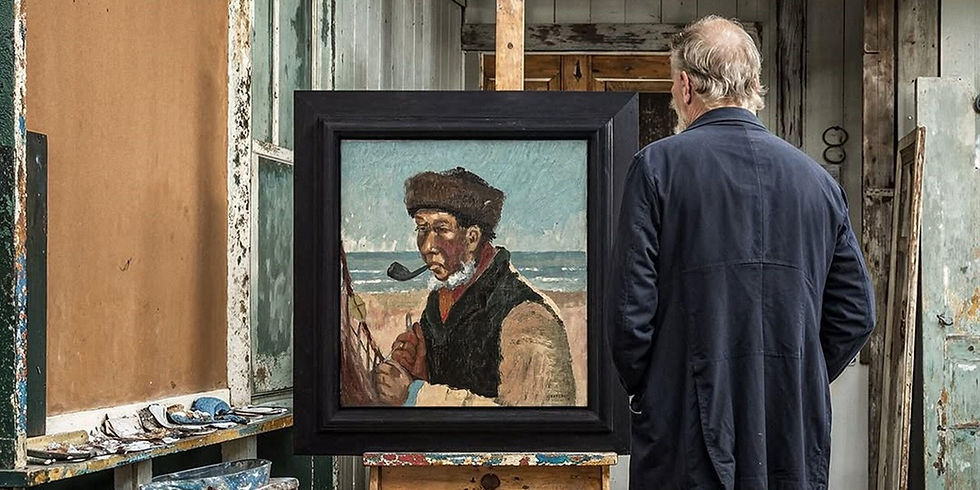
A remarkable story recently captured the attention of collectors, appraisers, and art historians: a painting reportedly purchased at a garage sale for around $20 (some reports cite under $50) was later promoted as a potentially authentic work by Vincent van Gogh. The painting, known as Elimar, became the subject of an extensive investigation that highlights both the possibilities and the limitations of modern art authentication.
The Discovery
According to published accounts, an antiques collector acquired the painting at a garage sale in Minnesota in 2016. The work depicts a fisherman smoking a pipe and repairing a net by the sea. After the purchase, the collector began to suspect that the brushwork and impasto might resemble works associated with Van Gogh's late period.
In 2019, the painting was reportedly acquired by LMI Group International, which launched a multi-year investigation into its origins. The company assembled a team of experts and invested significant resources into scientific and historical analysis.
The 400+ Page Investigation
One of the most discussed aspects of the case is the extensive report produced by LMI Group. Multiple sources describe the report as approximately 456–458 pages long and state that it included technical examinations of pigments, canvas, fibers, handwriting, historical references, and other comparative analyses. The investigation reportedly concluded that the painting could have been created between 1889 and 1890, during the period when Van Gogh was working in Saint-Rémy-de-Provence.
LMI Group argued that the materials used in the painting were consistent with those available during Van Gogh's lifetime and presented additional research intended to support the attribution. Some reports also mention analysis of a hair embedded in the paint and other forensic-style examinations.
The Van Gogh Museum's Response
Despite the extensive report, the Van Gogh Museum did not accept the attribution. The museum had previously reviewed the painting and rejected it on stylistic grounds. After reviewing the new material, it reportedly maintained its position that Elimar is not an authentic Van Gogh.
This disagreement illustrates a crucial reality in the art world: scientific testing can provide valuable evidence, but it does not automatically override expert connoisseurship, provenance research, and institutional judgment. Authentication often depends on the convergence of multiple forms of evidence rather than a single test.
Why This Case Matters
The Elimar controversy is not just about one painting. It is a case study in how authentication works in practice.
Several important lessons emerge:
A low purchase price does not determine authenticity.
Important discoveries have occasionally emerged from flea markets, estate sales, and garage sales. However, the vast majority of such finds do not turn out to be masterpieces.
Scientific analysis is powerful but not definitive.
Pigment dating, canvas analysis, and forensic testing can rule out impossible attributions and strengthen or weaken a case, but they rarely provide absolute proof on their own.
Provenance remains critical.
A well-documented ownership history is often one of the strongest forms of evidence in authentication disputes. In cases where provenance is incomplete, uncertainty increases.
Institutional recognition matters.
For artists such as Van Gogh, major museums and scholarly authorities play a significant role in determining whether a work is broadly accepted by the market.
What Antique Cabinet Would Look For
At Antique Cabinet, cases like this illustrate why professional evaluation should combine:
Stylistic analysis
Technical examination
Provenance research
Comparative market research
Historical documentation
Clear disclosure of limitations and uncertainties
An appraisal or authentication opinion is strongest when multiple lines of evidence point in the same direction. When the evidence conflicts—as in the Elimar case—the responsible conclusion may be that the work remains disputed rather than definitively authentic or inauthentic.
Final Thoughts
The idea that a $20 garage sale purchase could be a lost Van Gogh is irresistible. Yet the ongoing debate surrounding Elimar demonstrates that extraordinary claims require extraordinary evidence. A 400+ page investigation, scientific testing, and expert analysis can generate a compelling case, but acceptance by leading scholarly authorities remains a separate hurdle.
For collectors, the takeaway is not that every bargain is a hidden masterpiece. Rather, it is that careful documentation, professional appraisal, and rigorous authentication are essential whenever an object appears to have exceptional significance.
Disclaimer: This article summarizes publicly reported information and should not be interpreted as an authentication opinion regarding the painting known as “Elimar.”
Sources include reports from ArtMajeur Magazine, Ocula, Mpls.St.Paul Magazine, Hyperallergic, Observer, The Wall Street Journal, and other cited publications.


Comments