
Art Valuation Guide: How Appraisers Determine Worth and How to Appraise My Art Online

A painting can hang quietly in a hallway for decades, then suddenly raise a very loud question: what is it worth?
Art value is rarely based on beauty alone. A compelling image helps, but appraisers look far beyond taste. They study who made the work, whether the attribution is reliable, where it has been, what condition it is in, and how similar works have performed in the art market. Two paintings that look similar to a casual viewer can carry very different values once those facts come into focus.
That is why art valuation is part research, part connoisseurship, and part market analysis. Whether the work is an inherited oil painting, a drawing bought years ago, a sculpture, or a mixed-media piece, the same core questions guide the process.
This guide explains how appraisers determine worth and what to prepare if the question is, “how to appraise my art” from home. It is informational only and should not replace a formal appraisal for insurance, estate, donation, or legal purposes.

Art value begins with facts, not guesses
The first stage of a fine art appraisal is identification. Before an appraiser can estimate value, they need to know what the object is.
That sounds simple, but art often arrives with uncertainty. A signature may be difficult to read. A family story may have changed over time. A work may be “after” a known artist, made by a follower, copied from a published image, or produced in a studio rather than by the named artist. Each possibility affects value.
Appraisers usually begin by recording the basics:
Artist name or possible attribution
Title, if known
Date or estimated period
Medium and materials
Dimensions
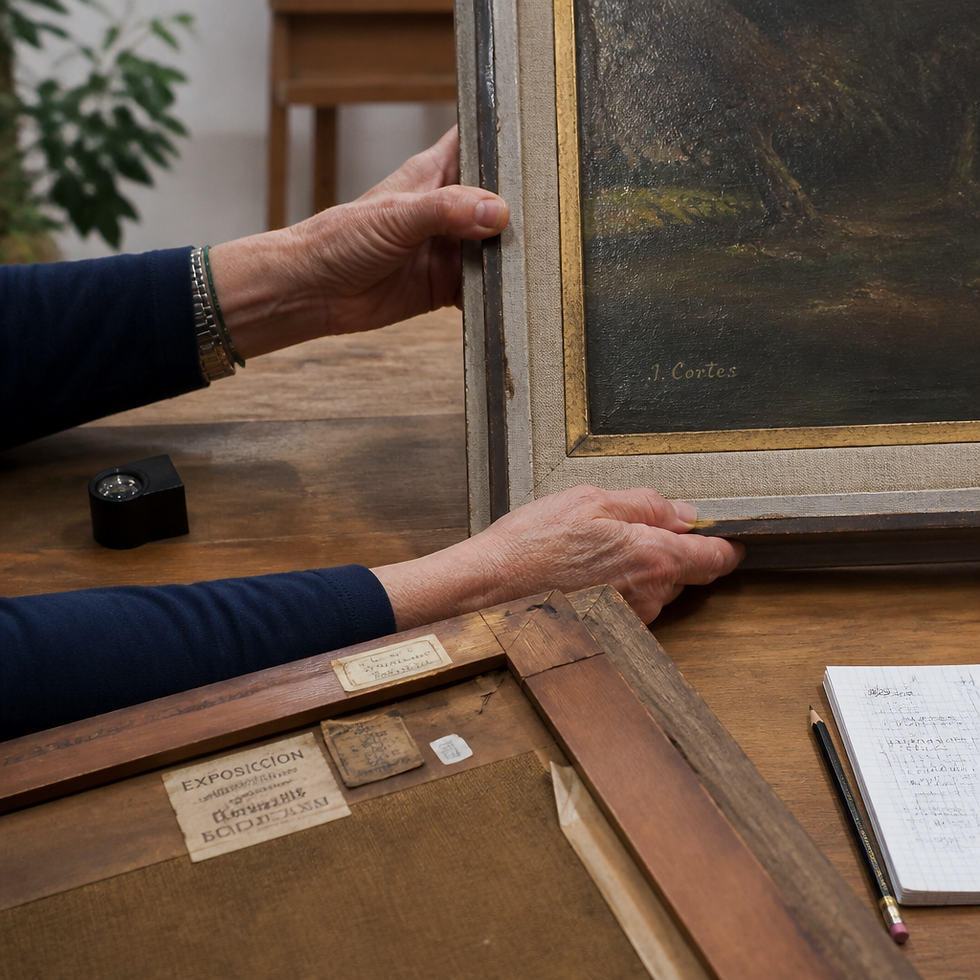
Signature, inscriptions, labels, or marks
Condition notes
Ownership history
Any past appraisals, invoices, or correspondence
These details create the foundation for a credible opinion of value. Without them, any number is only a rough guess.
Artist attribution carries major weight
Artist attribution answers the question, “Who made it?” In art valuation, this can be the single most important factor.
A work firmly attributed to a recognized artist may have a strong market. A similar work by an unknown artist may still be beautiful, but it will usually be valued differently. The wording matters:
Attribution wording | What it usually suggests |
By the artist | Strong evidence that the named artist made the work |
Attributed to the artist | Likely or possible, but not fully confirmed |
Studio of the artist | Made in the artist’s workshop or circle |
School of the artist | Made by someone influenced by the artist, often from the same region or period |
After the artist | A copy or later interpretation of an existing work |
Small language changes can mean large value changes. An appraiser studies signatures, materials, style, subject matter, and documented records to decide how strong the attribution is.
Authenticity must support the attribution
Authenticity is related to attribution, but it is not the same thing. Attribution asks who likely made the work. Authenticity asks whether the work is genuine as described.
An appraiser may look at:
Whether the materials match the claimed period
Whether the artist’s signature is consistent with known examples
Whether the style fits the artist’s development
Whether labels, stamps, or gallery records appear credible
Whether restoration or later additions confuse the original work
Some cases need technical testing or expert review. An appraiser may recommend conservation analysis, pigment testing, paper analysis, or review by a specialist. Strong appraisers know when a question sits outside their own expertise.
Provenance, period, and medium shape the story
A work of art is an object, but it is also a record. Its ownership history, age, materials, and place within an artist’s career all influence value.

Provenance can strengthen confidence
Provenance means the ownership history of a work. It can include purchase receipts, estate records, exhibition labels, letters, photographs, old inventory numbers, and previous appraisal documents.
Clear provenance can help establish authenticity and market appeal. A painting that passed through a respected collection, appeared in an estate inventory, or has a long documented chain of ownership may attract more confidence than a similar work with no history at all.
Provenance does not automatically create high value. A weak painting with strong paperwork may still have limited demand. But when the artwork itself is desirable, good provenance can support a higher appraisal value.
For anyone starting an art appraisal online, provenance documents are often just as important as photographs of the artwork. Images of the front, back, signature, frame, labels, and paperwork can help an appraiser decide what research path to follow.
Period affects desirability
An artist’s career usually has phases. Early works, mature works, experimental works, and late works may not command the same prices.
Collectors often respond most strongly to the period that best represents an artist’s recognized style. If an artist is known for bold abstract canvases from a certain decade, a small early academic study may appeal to a different group of buyers. It may still matter, but the market may treat it differently.
The same applies to broader art categories. A 19th-century portrait, a mid-century abstract painting, and a contemporary mixed-media piece each have their own buyer base, price history, and market rhythm.
Medium can raise or limit value
Medium matters because collectors often place different values on different types of work by the same artist.
In general, unique works such as oil paintings, large sculptures, or fully developed drawings tend to command more than prints or multiples, assuming quality and demand are comparable. That said, some prints are valuable when they are rare, signed, early, or central to an artist’s body of work.
Common medium categories include:
Oil on canvas or panel
Acrylic on canvas
Watercolor or gouache
Pastel, charcoal, pencil, or ink
Printmaking, including etching, lithograph, screenprint, and woodcut
Sculpture in bronze, stone, wood, ceramic, or mixed media
Photography and digital-based works
Textile, collage, and assemblage
An appraiser considers whether the medium is typical for the artist, whether collectors favor it, and whether the materials have aged well.
The object itself still matters
Market history and documentation are powerful, but the work still has to stand on its own. Subject matter, size, condition, and rarity can all change value.
Subject matter can attract or narrow demand
Collectors often favor certain subjects by certain artists. For one painter, landscapes may be the most desirable. For another, portraits, still lifes, city scenes, or abstract compositions may lead the market.
Subject matter also affects how easy the work is to place. A serene coastal scene may appeal to more buyers than a highly personal family portrait. A major historical scene may have institutional interest. A small sketch of an everyday object may matter if it connects to a famous finished work.
Desirable subject matter usually fits at least one of these patterns:
It represents what the artist is best known for
It has strong visual impact
It connects to a documented series or period
It appeals to current collector taste
It has cultural, historical, or regional significance
This is one reason people searching “how much is my painting worth” often need more than a quick image review. The image matters, but context tells the appraiser how the market may read it.
Size influences value, but not always in a straight line
Larger works often bring higher prices because they have more presence and can represent greater ambition. Still, size is not a simple formula.
A very large painting may be harder to sell if it does not fit easily in homes. A small but exquisite work by a sought-after artist may perform better than a large, weaker example. Appraisers compare size within the artist’s own market, not by using one rule for all art.
For prints and editions, size can also matter, but edition size, condition, signature status, and image desirability may matter more.
Condition can protect or reduce value
Condition has a direct effect on art appraisal value. Damage, fading, tears, flaking paint, staining, warping, poor restoration, mold, and unstable supports can reduce worth.
Some condition issues are expected with age. A centuries-old work may show surface wear and still be valuable. The question is whether the condition affects appearance, stability, originality, and buyer confidence.
Appraisers often look for:
Paint loss or cracking
Canvas relining or patching
Paper discoloration or foxing
Tears, creases, or water stains
Overpainting or heavy restoration
Frame damage
Loose mounts or unstable supports
A clean condition report from a qualified conservator can help, especially for higher-value works. Cleaning or restoration should not be rushed before an appraisal. Poor treatment can do more harm than good.

Rarity can increase competition
Rarity means supply is limited in a meaningful way. A work may be rare because the artist produced few pieces, because few works from a period survived, or because the subject matter seldom appears on the market.
Rarity alone does not guarantee value. A rare work with little collector demand may remain modest. But when rarity meets desirability, prices can rise. If collectors rarely get the chance to buy a strong example by a known artist, competition may shape the final market value.
Public history and market evidence turn research into a value opinion
After identification and object analysis, appraisers turn to public records and market evidence. This is where art-market value becomes more measurable.
Exhibition and publication history can add authority
A work that has been exhibited or published carries a public record. That record can help confirm importance, provenance, and identity.
Useful documentation may include:
Exhibition catalogs
Museum or gallery labels
Newspaper clippings
Scholarly references
Catalogue entries
Photographs of the work on display
Inclusion in artist monographs or catalogues
Publication history can be especially valuable if scholars recognize the work as part of an artist’s known output. Exhibition history may matter more when the show was selective, important to the artist’s career, or connected to a major movement.
Not all exhibitions carry the same weight. A local community display is different from inclusion in a respected curated exhibition. Appraisers judge the quality and relevance of the record.
Comparable auction results show what buyers have paid
Comparable sales, often called “comps,” are central to art valuation. Appraisers review public auction results and other known market data for similar works.
The best comparables share several traits:
Same artist
Similar period
Similar medium
Similar subject
Similar size
Similar condition
Similar level of documentation
Recent enough to reflect the current market
A painting by the same artist is not automatically a good comparable. If one work is a major oil on canvas from the artist’s strongest period and another is a small unsigned sketch, the sales data may not translate.
Appraisers also look beyond the hammer price. They consider whether a work sold, failed to sell, exceeded expectations, or appeared during a strong or weak market moment. An unsold lot can be as informative as a successful sale, because it may reveal the price level buyers resisted.
Searches such as antique art appraisal, art valuation online, painting appraisal, fair market value of art, and “how much is my art worth” all lead back to the same principle: the strongest valuation connects the object to real market behavior.
Current demand can change the number
The art market is not fixed. Demand changes with collector taste, scholarship, museum attention, interior trends, economic conditions, and availability.
An artist may gain attention after a major exhibition, renewed critical interest, or a shift in collecting priorities. By contrast, a once-popular category may soften if fewer buyers pursue it.
Current demand affects:
How quickly a work may sell
Which selling venue makes sense
Whether collectors compete
How much risk buyers see
Whether estimates should be conservative or ambitious
This is why a dated appraisal may no longer reflect current art-market value. A valuation prepared years ago can be useful background, but it may need updating.
How to appraise my art online without losing the important details
Online appraisal can be a practical first step, especially for inherited works, estate planning questions, collection reviews, or early research. The quality of the result depends heavily on the information provided.
Good photographs matter. Appraisers need clear images, not dramatic lighting or filters. Include:
The full front of the artwork
The full back
Close-ups of the signature or inscriptions
Labels, stamps, and gallery marks
The frame, if relevant
Any damage or repairs
Receipts, letters, certificates, or past appraisals
Measurements of the artwork, not only the frame
Describe what is known and what is only family memory. A story can be useful, but an appraiser must separate documentation from tradition.
It also helps to state the purpose of the valuation. Insurance replacement value, fair market value, auction estimate, and estate value are related but not identical. A single artwork may have different values depending on the assignment.

A useful appraisal explains the why behind the number
A strong appraisal should do more than give a figure. It should explain the reasoning behind the figure.
Look for valuation language that connects the conclusion to evidence:
What attribution is being used
What authenticity assumptions apply
What provenance supports the work
How period, medium, subject, size, and condition affect value
Which comparable sales are relevant
How current demand influences the estimate
What limitations remain
A number without reasoning is hard to trust. A well-supported value opinion gives a clearer view of both the artwork and its place in the market.
If you are ready to begin with expert guidance, you can learn more about art appraisal and valuation services.
The real value of art appraisal is clarity
Art can be emotionally valuable, historically interesting, visually powerful, and financially meaningful at the same time. An appraisal does not reduce the work to a price. It helps explain where that price comes from.
The best art valuation starts with careful identification, tests assumptions, studies the object, reviews documentation, and compares the work with real market evidence. Artist attribution, authenticity, provenance, period, medium, subject matter, size, condition, rarity, exhibition history, comparable sales, and current demand all work together.
If the question is “how to appraise my art,” start with clear photos, honest background information, and any documents you have. From there, a qualified appraiser can turn scattered clues into a reasoned opinion of value, and that clarity is often the most useful discovery of all.


Comments